One inbox for every shopper channel — built by the team that runs it

We built Hermes because owning the platform gives us operational control that providers using third-party tools do not have. Every ecommerce engagement runs on the same interface — messaging and voice AI, human agents, and the live CSAT and QA data you see in your client dashboard.
  • Native speakers in 8 languages
  • 98.5% CSAT
  • Under 3% agent turnover
  • 24/7 across all channels
✓

Native speakers in 8 languages

24/7 across all channels

98.5% CSAT

Under 3% agent turnover

Why we built our own stack instead of renting tools

Running outsourced customer service is one operation—routing, agents, AI, QA, and client reporting. We built Hermes because that only works when everything runs on the same platform we use every day.

When we started scaling ecommerce customer service in 2014, the tools on the market did one thing well each — ticketing here, chat there, QA in a spreadsheet — but they did not match how we wanted to run a multilingual, multi-channel ecommerce operation with humans and AI on the same floor.

Renting a generic stack would have meant fitting our workflows to someone else's product roadmap: fixed escalation models, AI as an add-on, and client reporting that never quite matched what we saw internally. We built Hermes so classification, agent-assist, inbox, and quality monitoring live in one place — the same application our agents use and the same dashboards you can log into.

Owning the application also means we can extend it when a client needs something specific — a Shopify or marketplace integration, a handoff rule for voice AI, or a returns view — without waiting on a vendor's backlog. You get a managed customer service operation; we carry the product work.

01

Operational control

Workflows, routing, and escalation rules reflect how we agreed to run your shop — not the defaults of off-the-shelf SaaS.
02

AI in the core, not on top

Classification, drafting, and monitoring are part of Hermes — not a separate bot product wired in after the fact.
03

One source of truth

Volume, response times, CSAT, and QA scores come from the same live data we use to manage your team — visible in your client dashboard.
04

Built for outsourced delivery

Hermes is designed for teams running many brands, languages, and marketplaces — not for a single company configuring their own helpdesk once.

Email, chat, voice, social — one thread

Shoppers reach you on the channel they prefer. Agents and AI see one thread history, one knowledge base, and one set of escalation rules.

01

Email

Structured ticketing with classification, drafting, and routing — the same QA checkpoints as every other channel.

02

Live chat & messaging

Website chat, WhatsApp, Instagram, and Messenger share knowledge, tone, and human handoff when judgement is needed.

03

Telephone

Inbound and outbound calls with warm transfer to trained agents when voice AI or scripts reach their limits.

04

Social media

Public and private messages handled with the same escalation and quality framework as the rest of your support.

AI in the workflow, not a bolt-on bot

Classification, response drafting, routing, and exception flagging are native to Hermes — not a third-party AI layer bolted on top.

01

Ticket classification and routing

Incoming contacts are read, classified by type and urgency, and routed in seconds — before an agent opens the case.
02

Drafting for routine work

Predictable order and product queries get AI-drafted replies from your knowledge base; agents review, adjust, and approve before anything goes out.
03

Human escalation with context

Sentiment, topic, and out-of-scope triggers route conversations to people with full thread and order context already in the inbox.

The metrics we run on — in your login

You log in and see contact volume, response times, CSAT scores, and QA data — updated continuously. The same metrics we use to run your operation.
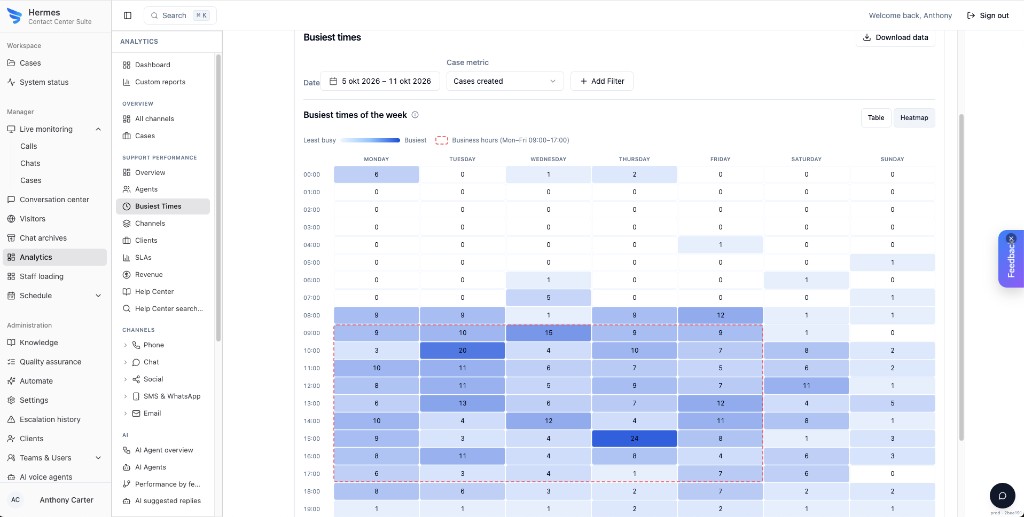
Hermes Contact Center Suite analytics view: a weekly heatmap of busiest times for cases created, with manager tools for live monitoring, channels, and quality assurance.

Integrations

Your shop, your helpdesk — one operation

We plug into Shopify, marketplaces, and helpdesks you already use — or run customer service entirely on Hermes when you prefer one inbox.

Helpdesk & CRM

Zendesk, Gorgias, Freshdesk, Salesforce, HubSpot, Intercom

Ecommerce & marketplaces

Shopify, Magento, WooCommerce, BigCommerce, Amazon Seller Central, Bol.com, Kaufland

What runs on Hermes for ecommerce clients

Hermes is the foundation behind every AI-assisted and human channel we run for ecommerce clients.

Common questions about Hermes

Is Hermes a product I can buy separately?
Hermes is our operating platform for outsourced ecommerce customer service. Clients get dashboard access and transparent reporting; we run discovery, configuration, and day-to-day operation on your behalf.
Do we have to migrate off Gorgias or Zendesk?
No. We integrate with Zendesk, Gorgias, Freshdesk, Intercom, and similar tools so your team sees first-line work where they expect it. Alternatively, we can run the full operation on Hermes if you want one inbox.
How does Hermes relate to messaging and voice AI?
Customer-facing Messaging and Voice AI escalate to trained agents on Hermes — same inbox, same quality framework, full conversation and order context. AI resolves routine work; people handle judgement and empathy.
What reporting do clients see?
Real-time volume, response times, CSAT, and QA scores from the same data we use internally — including heatmaps and manager tools for monitoring channels and quality.

Tell us your channels and stack

Tell us about your channels, order volume, and stack. We will explain how we would run customer service on Hermes — or alongside your existing helpdesk.