
Human experts
Native-speaking agents trained on your product, documentation and escalation playbooks — a team aligned with the resolution and CSAT targets you care about.
Multilingual support →Outsourced technical support
Technical support from €1,500/month
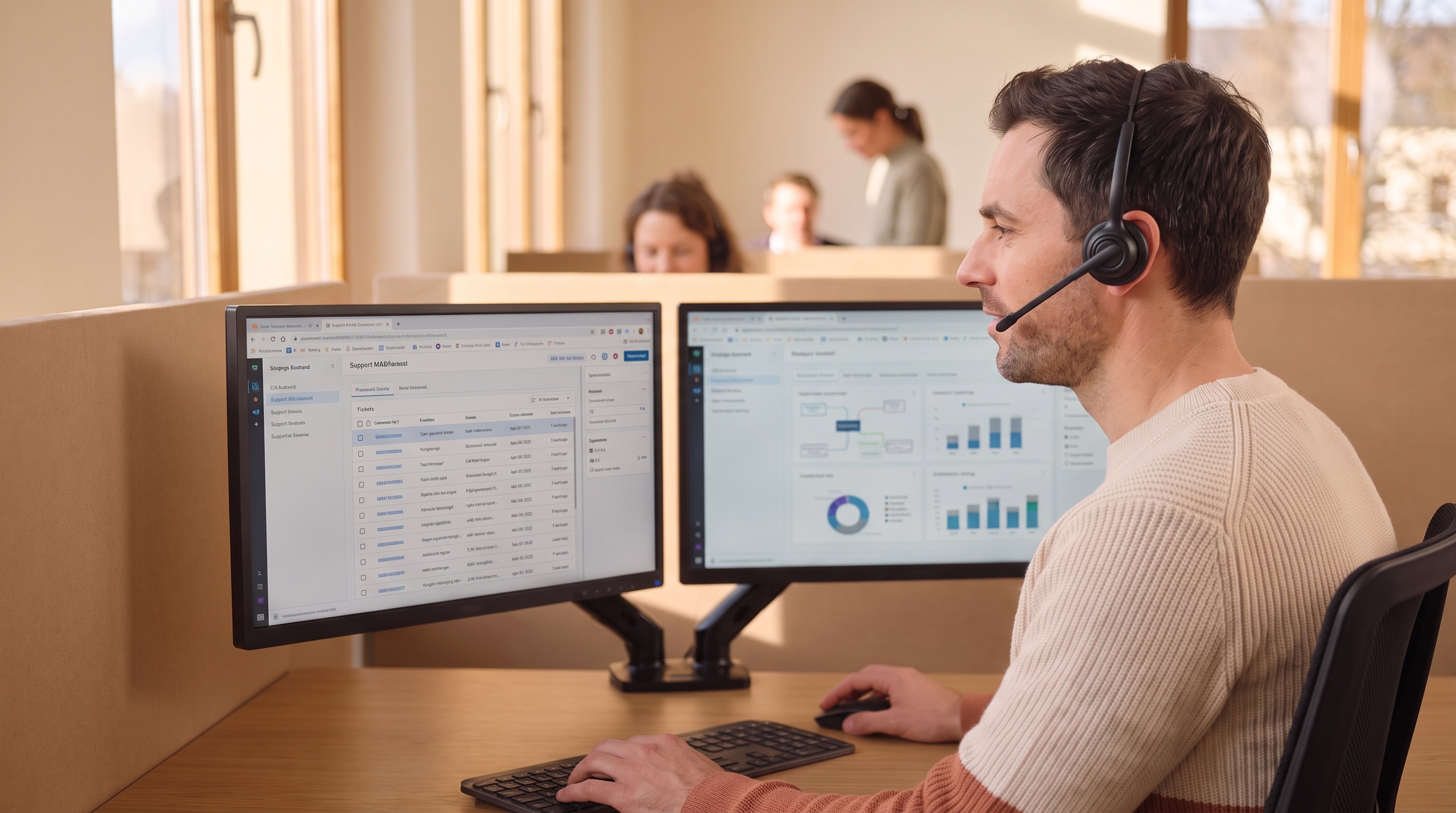
Native speakers in 8 languages
24/7 English support
98.5% CSAT
Under 3% agent turnover
Trusted by teams at



The ecosystem connecting people and AI
Native-speaking agents trained on your product, documentation and escalation playbooks — a team aligned with the resolution and CSAT targets you care about.
Multilingual support →Hermes, our own platform, classifies contacts, drafts replies and routes every case — so agents spend their time on the troubleshooting that needs judgement.
AI-assisted support →One team across email, phone, live chat and WhatsApp. AI handles triage and the routine; agents take the cases that need deep product knowledge — in eight languages.
Every ticket your engineers handle is time they are not spending on your product. First-line technical support — installation questions, configuration issues, basic troubleshooting — does not require your most experienced people. But if nobody else is handling it, your most experienced people end up doing it anyway.
Scaling technical support internationally makes it harder. Hardware users in Germany expect support in German. Software customers in France expect someone who understands their system and speaks their language. Building a multilingual first-line support team internally is expensive, slow, and difficult to maintain as your product evolves.
And every support interaction that goes badly — slow response, wrong answer, a user who feels passed around — damages the trust your product team worked hard to build.

We have been providing first-line technical support for hardware and machine manufacturers and software vendors since 2014. We know the difference between a user who needs hand-holding through a standard installation and one whose issue requires escalation to your engineering team. We know how to write an escalation note that gives your second-line team everything they need without requiring the user to repeat themselves.
Our agents are trained specifically on your product before they handle a single live contact. We build troubleshooting guides, decision trees, and escalation playbooks from your documentation and from working sessions with your technical team. When a user contacts us with a problem, our agent is equipped to resolve it at first contact — or escalate it correctly if they cannot.
We are software builders as well as support operators. We build and maintain most of the applications that run our business — including our contact centre platform, which comprises roughly 500,000 lines of code. That is why we understand what it takes to keep a product supported as it evolves, and why we take release coordination, bug triage, and structured escalation seriously.
Step 1
Before we handle a single contact, we immerse ourselves in your product. We review your documentation, your known issues, your most common user questions, and your existing escalation logic. We work with your technical team to build troubleshooting guides and decision trees that allow our agents to resolve the majority of first-line contacts without escalation.
Where escalation is needed, we define exactly what triggers it, what information we collect before escalating, and how we hand off to your second-line team. Clear escalation paths protect your engineers' time and give users a seamless experience.
Step 2
We train agents on your product during onboarding — not generic scripts. They only handle live contacts once they meet your product knowledge bar.
Every engagement runs on our own platform: all channels in one interface, AI-assisted triage, and direct integration with Zendesk, Freshdesk, Intercom, Jira Service Management, and others — so your L2 team sees every first-line contact without switching tools. You get the same live dashboard we use: volume, response times, resolution and escalation rates, and CSAT.
Step 3
Your users contact us by their preferred channel — email, telephone, live chat, or WhatsApp, depending on what you offer. Our agents triage, troubleshoot, and resolve at first contact where possible. Where a contact requires escalation, we write a structured escalation note — problem description, troubleshooting steps already taken, system information — and pass it to your second-line team with everything they need to resolve it efficiently.
Step 4
Every month you receive a structured performance report: volume trends, resolution rates, escalation patterns, and recommendations. As your product evolves — new releases, new features, new failure modes — we update our knowledge base and troubleshooting guides accordingly. Your support operation improves as your product matures.
Clients can add a service level agreement covering first response times by channel, resolution timeframes for standard contact types, escalation response times, and quality thresholds. Where an SLA is in place, performance is reported in your real-time dashboard and in your monthly report. Nothing is estimated or approximated — performance against every agreed SLA is measured and documented.
Agreed per channel based on your users' expectations and your business requirements. For clients requiring 24/7 coverage, first response SLAs apply at every hour — not just during business hours. Response time is measured at the contact level and visible in your dashboard in real time.
When a first-line contact requires escalation to your L2 team, the timeframe from escalation to structured handoff is agreed during onboarding. For critical issues — hardware failures affecting business continuity, for example — out-of-hours escalation protocols with defined notification paths are agreed and documented before go-live.
A minimum QA score threshold is agreed per engagement. If average scores fall below threshold in any reporting period, we flag it proactively and implement a remediation plan. We do not wait for you to notice a quality issue — our QA monitoring identifies it in real time.
If an agreed SLA is missed, you see it in your client portal in real time, and you can receive notifications when configured thresholds are reached. SLA misses are also documented in the relevant monthly report with root cause analysis. For clients on service agreements with SLA credit provisions, these are applied automatically without requiring a formal dispute process.
Integrations
We work inside the helpdesks, chat tools, and channels your users already use. No migration and no parallel inbox — our agents plug into Zendesk, Freshdesk, Intercom, Jira Service Management, and the rest of your stack from the first week, with escalations logged where your engineering team expects them.
Helpdesk & CRM
Channels
Internal tools
For a plain-language explanation of what L1 covers in practice, see what first-line technical support means in practice.
We manage first-line technical support for hardware and machine manufacturers and software vendors across Europe, the US, and Canada. Our clients' engineering and second-line teams receive only the contacts that genuinely require their expertise — everything else is resolved at first contact by our trained agents.
We work best with hardware and machine manufacturers and distributors and software vendors at a specific point in their growth. This section is here to save us both time — if we sound like a good match, let us talk. If we do not, we would rather tell you now.
Not sure which side of the table you are on?Tell us about your product and your current support setup. We will give you an honest answer.
Need outsourced ecommerce customer service instead, or compare both services?

Serving hardware and software companies since 2014 · EU-based infrastructure