Where L1 runs — before engineering gets dragged in

We built Hermes because owning the platform gives us operational control that providers using third-party tools do not have. Every first-line technical support engagement runs on the same interface — AI triage, trained L1 agents, structured escalation to your engineering team, and the live data you see in your client dashboard.
  • Native speakers in 8 languages
  • 98.5% CSAT
  • Under 3% agent turnover
  • 24/7 across all channels
✓

Native speakers in 8 languages

24/7 across all channels

98.5% CSAT

Under 3% agent turnover

Built for outsourced L1, not off-the-shelf SaaS

First-line support is one operation—triage, L1, escalation, and the data your engineering team sees. We built Hermes so we are not stitching that together from someone else's product roadmap.

When we started scaling first-line technical support alongside ecommerce in 2014, the tools on the market separated ticketing, chat, voice and QA — but they did not match how we wanted to run multilingual L1 with clean handoff to engineering.

Renting a generic stack would have meant fitting our workflows to someone else's product roadmap: fixed escalation models, AI as an add-on, and client reporting that never quite matched what we saw internally. We built Hermes so classification, agent-assist, inbox, and quality monitoring live in one place — the same application our L1 agents use and the same dashboards you can log into.

Owning the application also means we can extend it when a client needs something specific — a Jira field mapping, a severity-based routing rule, or a bug-triage view — without waiting on a vendor's backlog. You get a managed L1 operation; we carry the product work.

01

Operational control

Workflows, routing, and escalation rules reflect how we agreed to run your L1 — not the defaults of off-the-shelf SaaS.
02

AI in the core, not on top

Classification, drafting, and monitoring are part of Hermes — not a separate bot product wired in after the fact.
03

One source of truth

Ticket volume, FCR, response times, CSAT, and QA scores come from the same live data we use to manage your team — visible in your client dashboard.
04

Built for outsourced delivery

Hermes is designed for teams running many products and languages — with escalation paths your second line already trusts.

Every channel. One escalation path.

Users reach you on the channel they prefer. L1 agents and AI see one thread history, one knowledge base, and one set of escalation rules.

01

Email

Structured ticketing with classification, drafting, and routing — the same QA checkpoints as every other channel.

02

Live chat & messaging

In-app chat and messaging share product knowledge, tone, and human handoff when diagnosis needs judgement.

03

Telephone

Inbound support calls with warm transfer and structured notes when scripts or AI reach their limits.

04

Portal & forms

Web forms and customer portals feed the same inbox with consistent triage and SLA tracking.

Triage and drafting built into the platform

Classification, response drafting, routing, and exception flagging are native to Hermes — not a third-party AI layer bolted on top.

01

Ticket classification and routing

Incoming tickets are read, classified by product area and severity, and routed in seconds — before an agent opens the case.
02

Drafting for routine work

Known issues get AI-drafted replies from your knowledge base; agents verify steps and approve before anything goes out.
03

Human escalation with context

Out-of-scope, bug-suspect, and premium triggers route to people with full thread history and triage notes for engineering.

L1 volume, FCR, escalations — live in your dashboard

You log in and see ticket volume, first response times, FCR, escalation rates, CSAT, and QA data — updated continuously. The same metrics we use to run your L1.
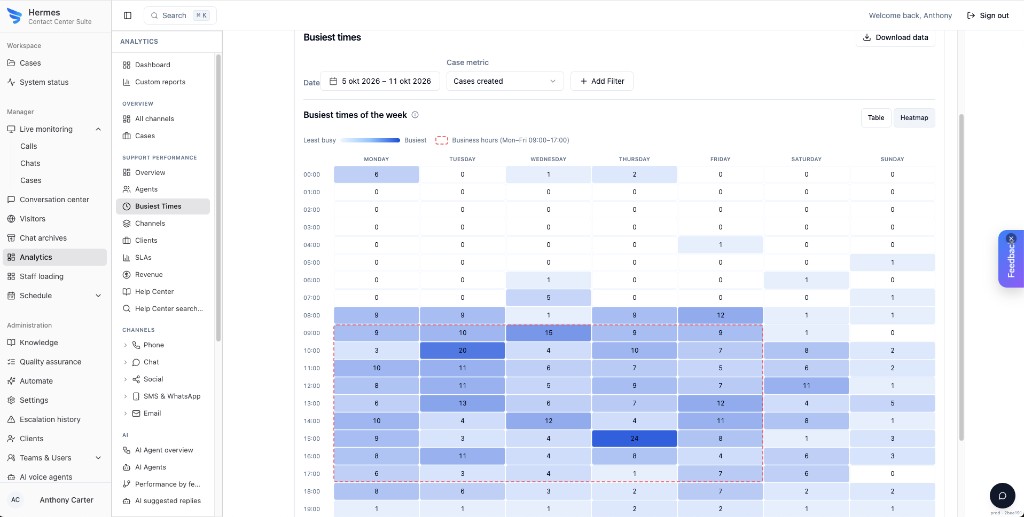
Hermes Contact Center Suite analytics view: a weekly heatmap of busiest times for cases created, with manager tools for live monitoring, channels, and quality assurance.

Integrations

Jira, Zendesk — or run L1 entirely on Hermes

We plug into Jira, your CRM, and existing ticketing — or run L1 entirely on Hermes when you prefer one inbox.

Ticketing & engineering

Jira Service Management, Zendesk, Freshdesk, ServiceNow, Linear

CRM & product

Salesforce, HubSpot, Intercom, custom APIs and webhooks

What runs on Hermes for software and hardware clients

Hermes is the foundation behind AI-assisted triage and human L1 we run for software and hardware clients.

Common questions about Hermes

Is Hermes a product I can buy separately?
Hermes is our operating platform for outsourced first-line technical support. Clients get dashboard access and transparent reporting; we run discovery, configuration, and day-to-day operation on your behalf.
Do we have to migrate off Jira or Zendesk?
No. We integrate with Jira Service Management, Zendesk, Freshdesk, and similar tools so engineering sees escalations where they expect them. Alternatively, we can run L1 entirely on Hermes if you want one inbox.
How does Hermes relate to AI-assisted technical support?
AI classifies and drafts on Hermes; agents verify and escalate with full context. The same quality framework and dashboards apply whether AI or humans handle the first touch.
What reporting do clients see?
Real-time volume, response times, FCR, escalation rates, CSAT, and QA scores from the same data we use internally — including heatmaps and manager tools for monitoring channels and quality.

Walk us through your product and escalation paths

Tell us about your product, ticket volume, and escalation paths. We will explain how we would run first-line support on Hermes — or alongside your existing tools.